Argentine Tango
· BootsnAll
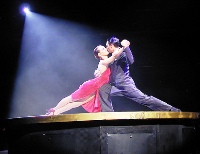 The Argentine Tango is a social dance which originated in Argentina and was later adopted in Uruguay and the rest of the world. Many people confuse the Argentine Tango with Ballroom Tango.
Origin and history
The beginnings of Argentine Tango can be traced to the working class port neighborhoods of Buenos Aires. For this reason, tango is also referred to as the music of the immigrants to Argentina. One of the most popular “origin stories” has it that tango came from the Niger Congo languages of Africa.
The dance itself derives from the Spanish habanera, the Uruguayan milonga and candombe and also contains elements from the African dances practiced by the community in Buenos Aires. The music is a fusion of styles from Europe.
Understanding the dance
Essentially, tango means to walk with the partner and music. It relies heavily on improvisation, although certain movements have been codified by instructors in order to instruct dancers. There isn’t a “basic step”. One of the constants in all Argentine tango styles is that the follower will usually be led to alternate feet. Also, the follower (the lady) rarely has her weight on both feet at the same time.
Argentine tango is danced counterclockwise around the outside of the dance floor. Generally, you won’t see experienced dancers in the center of the floor but you’ll see there either those you are not good at navigating the floor or those who perform “showy” patterns which need more space.
As opposed to ballroom tango, Argentine tango is constantly evolving. While in ballroom tango, the partners arch their upper bodies away from each other, in Argentine tango is exactly the opposite: the dancers' chests are closer to each other than are their hips.
Steps
Although an improvised dance, there are several steps which the dancers combine in a spontaneous manner, as determined by the lead. Those who start to learn the Argentine tango will have to understand the basics of it, such as:
The Argentine Tango is a social dance which originated in Argentina and was later adopted in Uruguay and the rest of the world. Many people confuse the Argentine Tango with Ballroom Tango.
Origin and history
The beginnings of Argentine Tango can be traced to the working class port neighborhoods of Buenos Aires. For this reason, tango is also referred to as the music of the immigrants to Argentina. One of the most popular “origin stories” has it that tango came from the Niger Congo languages of Africa.
The dance itself derives from the Spanish habanera, the Uruguayan milonga and candombe and also contains elements from the African dances practiced by the community in Buenos Aires. The music is a fusion of styles from Europe.
Understanding the dance
Essentially, tango means to walk with the partner and music. It relies heavily on improvisation, although certain movements have been codified by instructors in order to instruct dancers. There isn’t a “basic step”. One of the constants in all Argentine tango styles is that the follower will usually be led to alternate feet. Also, the follower (the lady) rarely has her weight on both feet at the same time.
Argentine tango is danced counterclockwise around the outside of the dance floor. Generally, you won’t see experienced dancers in the center of the floor but you’ll see there either those you are not good at navigating the floor or those who perform “showy” patterns which need more space.
As opposed to ballroom tango, Argentine tango is constantly evolving. While in ballroom tango, the partners arch their upper bodies away from each other, in Argentine tango is exactly the opposite: the dancers' chests are closer to each other than are their hips.
Steps
Although an improvised dance, there are several steps which the dancers combine in a spontaneous manner, as determined by the lead. Those who start to learn the Argentine tango will have to understand the basics of it, such as:
- Caminadas (walks, which are the basic steps)
- Baldoso (tile)
- Salida (beginning or exit)
- Resolución